

Why do we keep using words that obscure what we really mean?
As a poet, it’s amusing how the whole world has suddenly become obsessed with spotting AI patterns in language. For me, the problem isn’t one of recognition; it’s much deeper than that. The AI words so many of us use every day have the same shape, the same tone, the same slightly moist sheen. They may have been written by a machine, or by a person who has begun to write like a machine, or by someone for whom de-risking their communication trumps everything else - including meaning. What do you read, my lord? Polonius asks Hamlet. Words, words, words. His disdain for empty language compared to action.
This hollow language has always existed in offices. Drive alignment. Lean in. Cultivate talent. Mobilise transformation. It’s been with us for decades, and it's super useful for people who want to say something without really saying anything. To communicate without being judged, without committing to anything someone could hold you to. It seems vaguely impressive, gives the feeling of decisiveness without the friction of actually making a decision. A whole career can be conducted in linguistic uncertainty, and many are.
But something has shifted in the last eighteen months. Generative AI now produces corporate communication at industrial scale: pitch decks, all-hands emails, LinkedIn posts, performance reviews, mission statements, thought leadership. It produces them in a single, recognisable register. The "it's not X, it's Y" statements, em-dashes laid in like commas, the word quietly doing the work of an adjective in the absence of anything real. Words stacked in threes: bold, intentional, human. It’s taken the patterns of corporate communications from decades of hard working copywriters trying to please everyone, and industrialised it. That’s why people are starting to become uneasy.
Once you've noticed the smoothness you can't stop seeing it. It's everywhere. And we’ve started to write like it. The irony is, the more the words sound ‘meaningful’ and ‘important’, the more they seduce us into feeling we’ve created something smooth and friction-free, the more they are adding to the noise.
There is research on what this costs. A study published in Organization Science in 2025 analysed entrepreneurial pitches and found the vaguer the pitch, the less likely a company was to attract investor interest. Vague language, in other words, is not just stylistically unfortunate, it’s economically expensive. Olivia Bullock at the University of Florida ran a parallel experiment in August of the same year, surveying nearly 2,000 people who received either jargon-filled or plain-language versions of a workplace email. Jargon, she said, "doesn't just make them feel bad about the information they've been given. It makes them feel bad about themselves." So the cost of befuddling meaning with workplace slop isn't just confusion; it’s a workforce whose confidence is being undermined.
I have a list of phrases I've heard in client meetings, read in strategy documents, seen on graduated background powerpoints. I keep meaning to write a poem about them but it’s too difficult - you can’t write poetry about words that don’t mean anything. The unsettling thing is how often I add to that list, and how rarely anyone sticks up a hand and says ‘what does that actually mean?’
Don’t get me wrong - I’m not assigning blame. Sometimes that smooth phrase isn't the result of a deliberate dodge or a careless click. Working out what you want to say is hard. Holding a thought open long enough for the right word to surface takes more energy than reaching for the available one, and everyone’s exhausted.
With poetry, the whole craft is the discipline of refusing any word that hasn't earned its place, and reaching instead for the specific - the kingfisher, the spade, the cracked saucer. AI doesn’t do this, not because it lacks vocabulary, but because it lacks a stake. It has nothing to lose by saying efficiency drive instead of the morning I had to tell my team the funding fell through. It has no Tuesday. It will never ride a bicycle. It remembers no particular father, with a particular spade. What it does, brilliantly, is to write the average of every sentence ever written about a subject, which is precisely why they feel like nothing in particular.
We don’t need to abandon workplace dialect entirely; some of it is essential, and not every email needs to be a poem. Transformation, after all, is familiar to everyone. But we should notice when we're using hollow language out of safety, or laziness, or uncertainty. We should ask of our own sentences: would I say this out loud, to a person I respected? If they asked what I meant, could I answer? Could I replace this abstract verb with one specific thing that actually happened, or that I noticed, or was told?
This is how we give words meaning. Not ‘quietly’, but with intent.

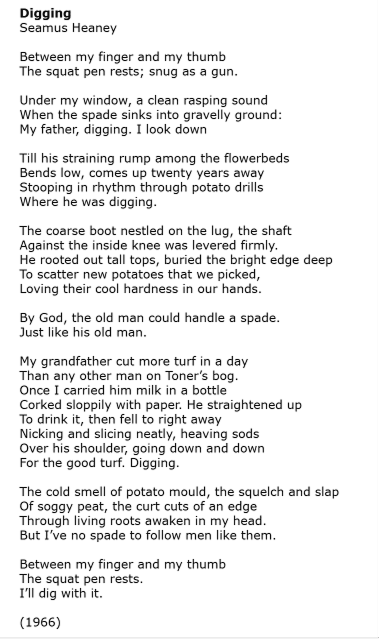
This issue's piece is "Digging," the opening poem of Seamus Heaney's first collection, Death of a Naturalist, written when he was trying to work out what writing was, and whether it counted as work. It does.
The Productive Struggle always includes something to try; an invitation to approach things differently, because the only way to build the capabilities we explore in this newsletter is to dive in, give it a go and let your brain do the work.
Take something you wrote for work this week. Could be from an email, message, a presentation slide, a report. Doesn’t matter if you used AI or wrote it yourself.
Print off a double spaced copy and read it out loud, slowly. Underline any words that sound important: Impact. Transformation. Growth. Next to each underlined word, write down one concrete thing it represents in your actual working week. Impact: the email a customer sent about how the new system made a difference. Growth: new hires in the Bristol office. If you can't think of a real example, maybe the word shouldn’t be there.
Now, rewrite the sentence using the real examples.
Abstract words feel safe because they evade judgement: ‘impact’ can mean anything, so it can't be wrong. Concrete examples commit to reality; that's why they're riskier, and it's what makes them meaningful.
You may be surprised how much you've been dodging meaning rather than pinning it down.
Thanks for reading my messy little newsletter.

Further reading links, for the relentlessly curious:
'Digging' © The Estate of Seamus Heaney, 1966, is from Death of a Naturalist published by Faber, and you can read more of Seamus Heaney's poetry in their Journal.
George Orwell, "Politics and the English Language" (1946) — free to read at the Orwell Foundation, eighty years on and still the foundational text.